In a World Where Women Still Menstruate in Huts…
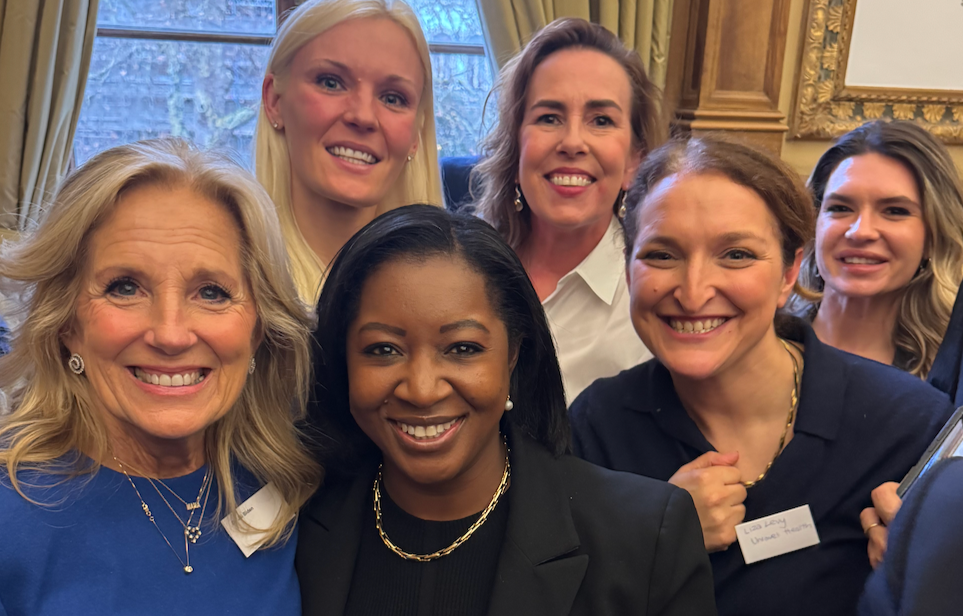
I recently had the privilege of sharing my thoughts on representing Calla Lily Clinical Care in the Milken Institute Health Women’s Health Network while at the London event a few weeks ago. Yes, that is me grabbing a photo with the former first lady. One of the points that I made during my interview was that the network is aiming to be a global force to elevate care and advocate for women everywhere. Yet there are parts of the world where women have a voice and there are parts where they don’t. I’m excited to be part of a network that can be a rising tide to lift all boats. As we make noise about the value of healthy women to a healthy society and healthy economy, I genuinely hope that conditions improve for women in places where a platform (and a mouth) such as mine aren’t available.
The example I used was this: how can we expect care and respect for women to change at the same pace globally when we still have parts of the world where women are sent into menstruation huts every month? Change can’t possibly occur at the same rate. But perhaps by speaking up about the taboos that still exist in our society, we can just begin to move the needle for places where the social stigmas are much more deeply engrained.
So let’s start with periods: Society has done a phenomenal job of pretending periods don’t exist. Unless you are sent to a hut. For the rest of us, it’s a quiet reality that girls and women go to great lengths to hide. I may be a bagless upright now, but I can remember what it was like.
We whisper about them. We use euphemisms. “Aunt Flo is here, can I borrow…?” (As if you are going to give that back.) We stick tampons in our shirt or sneak it quickly into a pocket like we’re smuggling contraband. We panic about leaking through clothes and feel the shame of another who has a stain on her butt. And we sure as hell don’t announce at a corporate board meeting that we need a quick bathroom break for a tampon change.
But why? At any given point, there are 800M women menstruating. Why can’t we talk about it? That lack of speech has consequences for our health. Millions of women are left in pain, misdiagnosed, or denied care because talking about menstruation makes people uncomfortable.
This isn’t just an uncomfortable truth—it’s a public health failure with real consequences.
Schools also skip over basic period education, while doctors lack the confidence (or ability) to recognize and treat debilitating menstrual cramps. “Heavy bleeding” is an abstract term that has some rough guidance but is largely subjective. “I can’t go to the grocery store because I can’t leave my house,” is probably considered “heavy,” but what about anything short of that? How bad do cramps need to be before you see a doctor? Most women don’t know because no one told them.
And when we refuse to talk about periods, we leave women with profound unmet needs and adverse health outcomes.
It’s time to fix this.
Harmful Silence and the Importance of Early Education
Pretending periods don’t exist hasn’t made them go away. It’s just made life harder for the people who have them. Education, healthcare, and public policy have all suffered because menstruation is still treated like a shameful secret.
Around 66% of girls know nothing about menstruation until their first period, and while the lack of awareness is concentrated in Asia, Africa, and the Middle East, it is also common in low-income households in the United States.
Minorities don’t fare much better. In one qualitative study of Black and Latina girls across three major cities, students said they received menstrual advice that was inadequate, outdated, and unrelatable (cue those cringeworthy educational videos from the 90s).
More broadly, only a handful of U.S. states mandate that menstruation be part of a school’s curriculum.
If you don’t teach people about their bodies, they’ll find answers somewhere else. And, let’s be honest, misinformation abounds on the internet—everything from “you can’t get pregnant on your period” (false) to searches titled DIY tampon alternatives (dangerous).
When basic education fails, society is left with individuals that are misinformed, ashamed, and less likely to seek medical help. This contributes to the sort of internalized stigma that can follow a woman for life and further perpetuate menstrual taboos.
Healthcare’s Gaping Hole in Menstrual Research
Medicine has a bad habit of discounting issues that primarily affect women, and menstrual health is no exception. We know more about erectile dysfunction than we do about endometriosis. Let that sink in for a moment.
The lack of menstrual health research leads to:
- Misdiagnosed or ignored period-related conditions. Endometriosis, adenomyosis, and PCOS affect millions, yet patients are often dismissed or told the pain is “normal” before receiving a diagnosis—a diagnosis which, in the case of endometriosis, can take up to 11 years after the onset of symptoms.
- Clinical trials that leave out menstrual data. Menstrual cycles can impact everything from drug efficacy to disease progression, but instead of studying this, researchers have typically excluded menstruating participants or ignored cycle-related variations.
- Period pain that isn’t taken seriously. Women who experience severe period pain are often handed ibuprofen and told to push through it—despite the fact that some experience pain so severe that it incapacitates them for days at a time.
The idea here is that periods are not just some niche inconvenience. They’re a core part of human biology that deserves an appropriate level of research, funding, and medical attention.
Talking About It Changes Everything
Periods aren’t mysterious, and the solution isn’t rocket science. However, it does require that we tackle the problem from all sides, and these are ideal places to start:
- Education needs to start earlier. No one should have their first period without knowing what’s happening to their body. My girls had “go bags” long before I thought they were developed enough to really expect Strawberry Week to start. But when it did, those bags had been there long enough that they knew what to do.
- Doctors need better training. That it can take over a decade to treat some period-related conditions is shameful. Period pain also needs to be acknowledged—especially when severe. Asking “when was your last period” is not taking a sufficient medical history.
- Research must include menstrual health. When clinical trials discount the impact of a menstrual cycle, medicine is less effective for half the world’s population.
And when innovative technology steps in? That may just be the icing on the women’s reproductive health cake.
The Bottom Line
The world needs a cultural shift in menstrual health. Menstrual stigma has stalled science, medicine, and education for generations. But the silence is breaking, and more people are talking, researching, and pushing for change.
The more we acknowledge the reality of menstruation, the better we can address the medical, educational, and policy gaps that have existed for too long.
Let’s start by getting women out of huts. While we work on that, let’s push for science where we can. A rising tide lifts all boats. Be the rising tide.
References
https://www.bristol.ac.uk/news/2024/june/menstrual-health-education.html
https://www.yalemedicine.org/conditions/endometriosis
https://pmc.ncbi.nlm.nih.gov/articles/PMC5585876/
https://onlinelibrary.wiley.com/doi/full/10.1002/sgp2.12107
https://www.weforum.org/stories/2024/01/women-healthcare-gap/
https://flo.health/menstrual-cycle/health/period/diy-menstrual-pads
https://genderpolicyreport.umn.edu/period-poverty-in-the-united-states-what-the-law-should-do/