Drug Discovery News: CLCC joins $50m program targeting antibiotic resistance
Original article here
Calla Lily joins $50M program targeting antibiotic resistance
A new intravaginal drug delivery platform has been selected to investigate whether localized UTI treatment can reduce the collateral effects of systemic antibiotics.
Written by Bree Foster, PhD
Aug 11, 2026

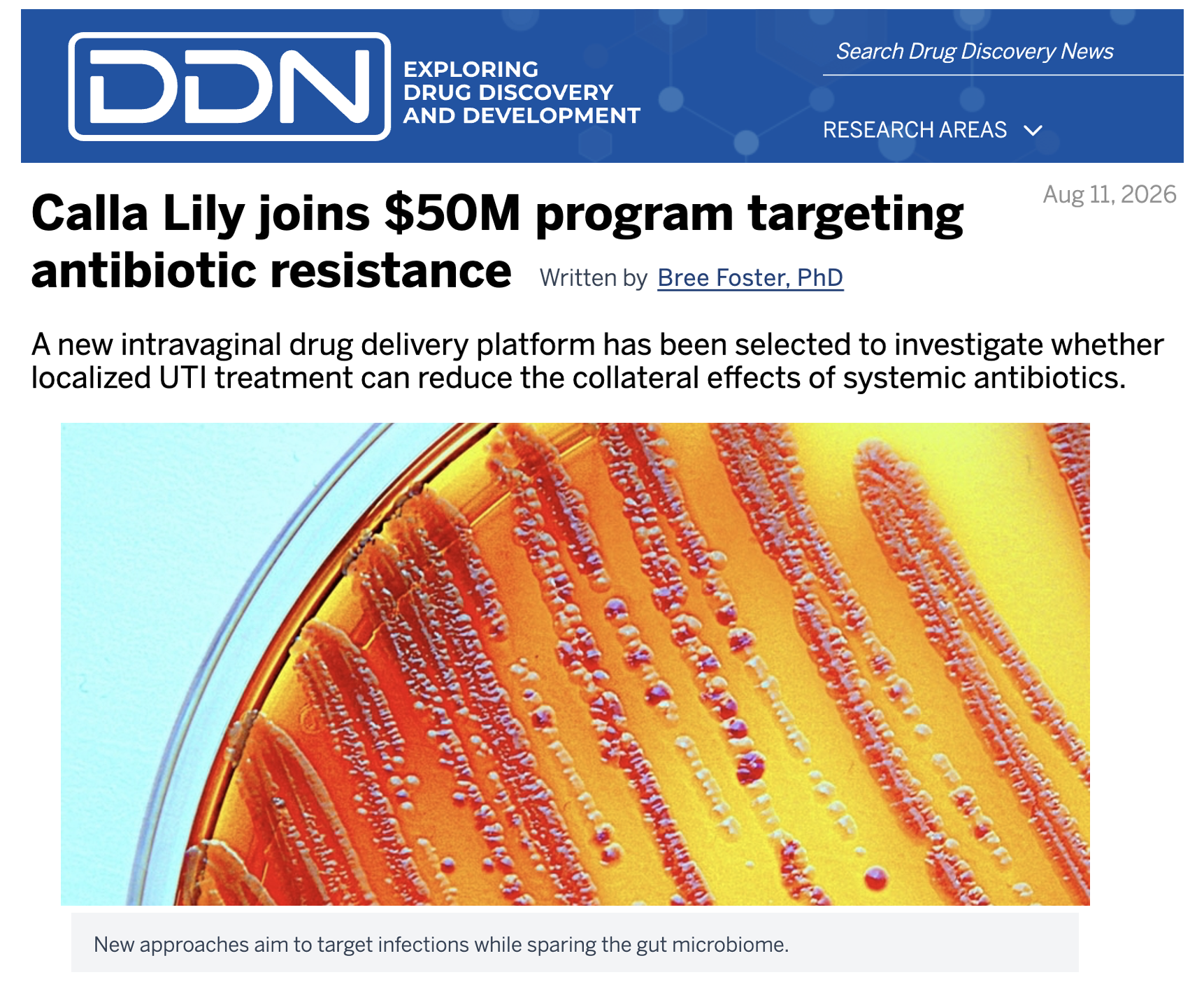
New approaches aim to target infections while sparing the gut microbiome.
credit: istock.com/Scharvik
Antimicrobial resistance (AMR) is increasingly recognized as a consequence not only of antibiotic-resistant bacteria, but also of the collateral effects of antibiotic treatment. Antibiotic administration can profoundly alter the composition and diversity of the gut microbiota, disrupt homeostasis, and create selective pressure that promotes the proliferation of antibiotic-resistant bacteria. According to Wellcome Leap, 85–90 percent of bacterial infections are localized, while nearly all antibiotics are delivered systemically.
This mismatch has prompted researchers to ask whether antibiotics could be made more precise — delivering drugs where they are needed while limiting exposure elsewhere in the body.
That is the premise behind Wellcome Leap’s $50 million Focused Antibiotics program, which is supporting approaches that aim to preserve antibiotic efficacy while sparing the gut microbiome. The program is exploring three strategies: activating or releasing antibiotics at the site of infection, altering drug pharmacokinetics to minimize gut exposure, and delivering antibiotics directly to the site of infection.
The latter approach is now being investigated by Calla Lily Clinical Care, which has been selected to participate in the program. The women’s health company will evaluate its Callavid intravaginal drug delivery platform as a potential way to deliver antibiotics locally for urinary tract infections (UTIs).
UTIs are one of the most common bacterial infections worldwide and disproportionately affect women, who receive almost 40 percent more antibiotics than men during their reproductive years. Yet first-line UTI antibiotics are currently administered systemically, exposing the gut microbiome to drugs that are intended to act elsewhere, and increasing the risk of antibiotic resistance.
“Women are disproportionately impacted by urinary tract infections, yet the consequences of that repeated systemic exposure have been largely overlooked,” said Lara Zibners, cofounder and Chair of Calla Lily Clinical Care, in the press release.
Callavid uses a tampon-like format to deliver drugs through the vaginal wall, potentially providing a route to concentrate an antibiotic around the urinary tract while reducing gastrointestinal and systemic exposure. Calla Lily expects the platform could limit systemic exposure to less than five percent, although the extent to which this can be achieved with an antibiotic formulation will need to be established through the program.
The approach represents one example of how the Focused Antibiotics program is attempting to address resistance without having to develop novel antibiotic molecules. Instead, the program is asking whether changing how existing antibiotics are formulated and delivered could reduce the selective pressure that drives resistance while maintaining treatment efficacy.
Wellcome Leap is initially focusing its program on UTIs, lower respiratory tract infections, and acute otitis media. For its first phase, the organization is seeking technologies that can be paired with existing antibiotics and demonstrate both efficacy against the target infection and minimal changes to the gut microbiome.
By scaling these formulations as first-line treatments for common outpatient bacterial infections, Wellcome Leap estimates that focused antibiotics could reduce antibiotic-driven resistant infections globally by as much as 40 percent, potentially preventing more than 100 million resistant infections within a decade of real-world use.
The program is also investigating the microbiome itself. A second phase aims to identify antibiotic-induced changes in the human gut microbiome that can predict the subsequent development of resistant bacterial infections with more than 80 percent accuracy. Such markers could help researchers understand which microbiome disruptions are most closely linked to resistance and provide a way to evaluate whether microbiome-sparing antibiotics are achieving their intended effect.
For Calla Lily, the UTI project builds on clinical work already underway with the Callavid platform. The FREEDOM trial is evaluating vaginal delivery of progesterone, assessing the platform’s safety, acceptability, and drug absorption. The study began in April 2026 and has passed its safety stopping rule, with 90 percent of participants having completed their first round of dosing to date.
The antibiotic project will test whether the same localized delivery concept can be applied to infection. If successful, it could provide a way to reduce unnecessary antibiotic exposure beyond the site of infection.
“Our ambition has always been for Callavid to become the defining platform for intravaginal drug delivery across a wide range of indications,” said Thang Vo-Ta, cofounder and CEO of Calla Lily Clinical Care, in the press release. “This marks a pivotal moment in demonstrating that when you solve for women, you solve for everyone.”