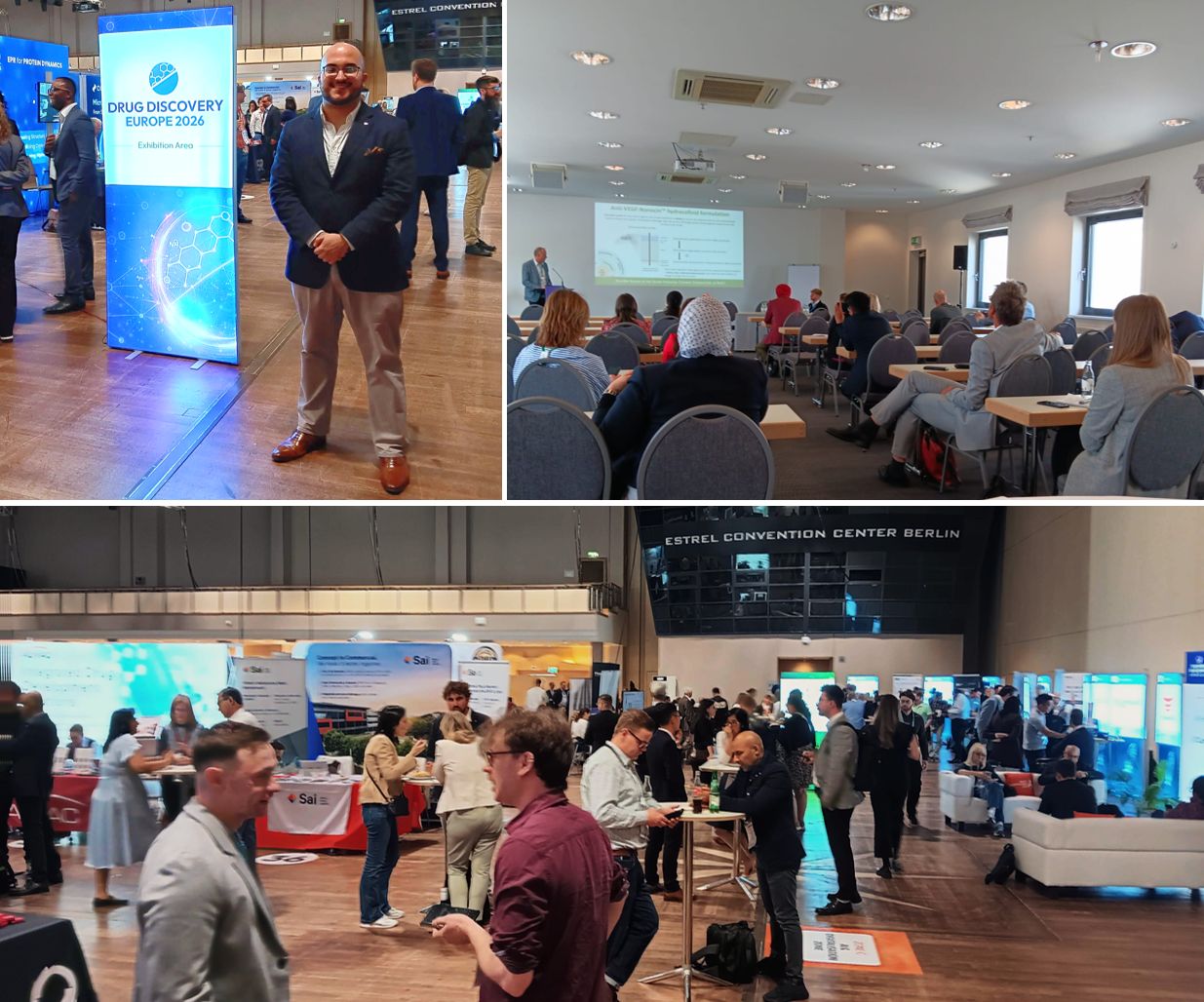
Forbes features CLCC
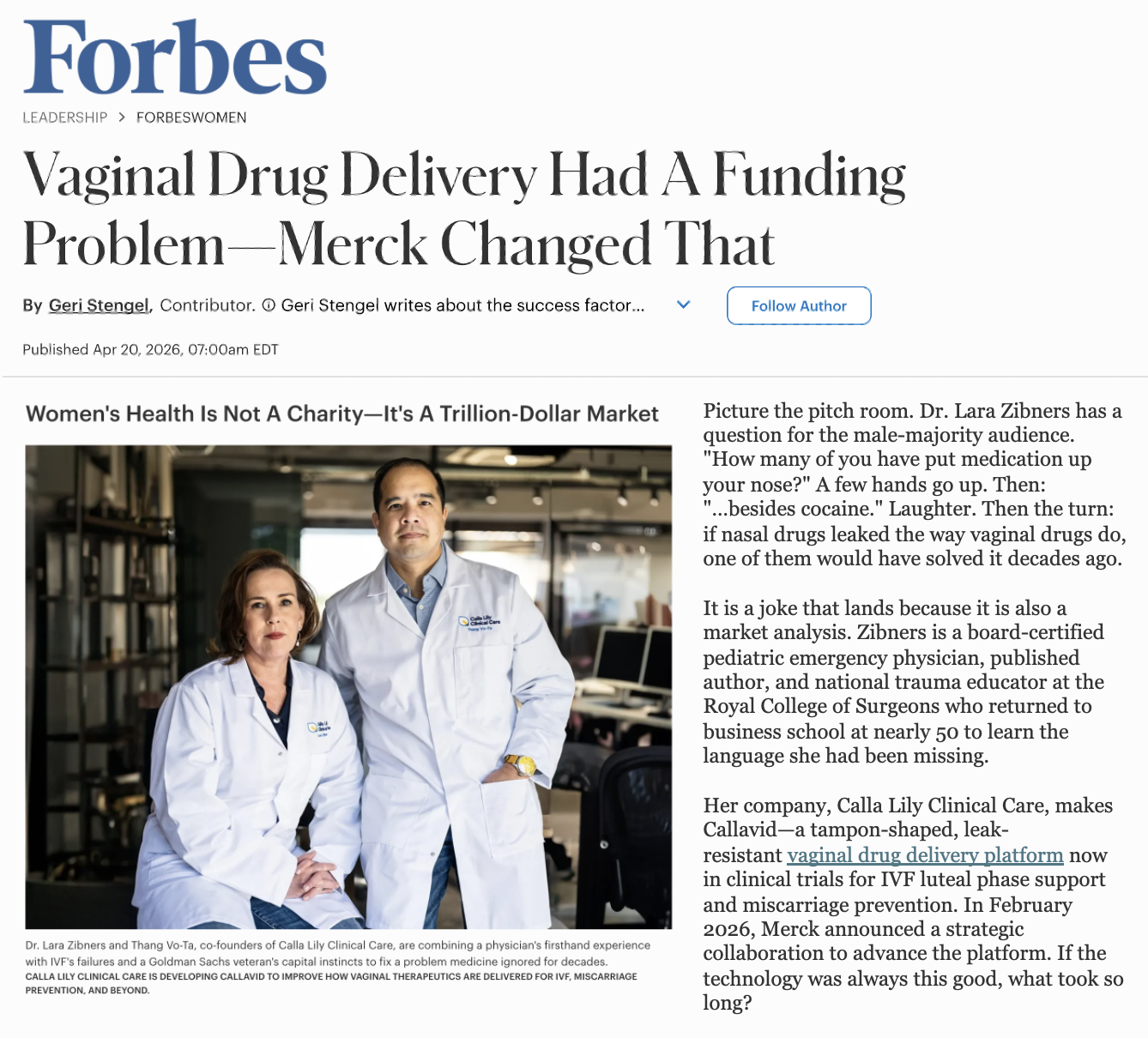
Original article here
by Geri Stengel
Picture the pitch room. Dr. Lara Zibners has a question for the male-majority audience. “How many of you have put medication up your nose?” A few hands go up. Then: “…besides cocaine.” Laughter. Then the turn: if nasal drugs leaked the way vaginal drugs do, one of them would have solved it decades ago.
It is a joke that lands because it is also a market analysis. Zibners is a board-certified pediatric emergency physician, published author, and national trauma educator at the Royal College of Surgeons who returned to business school at nearly 50 to learn the language she had been missing.
Her company, Calla Lily Clinical Care, makes Callavid—a tampon-shaped, leak-resistant vaginal drug delivery platform now in clinical trials for IVF luteal phase support and miscarriage prevention. In February 2026, Merck announced a strategic collaboration to advance the platform. If the technology was always this good, what took so long?
The answer starts with what investors think they are looking at. Thang Vo-Ta is Zibners’ co-founder and a former Goldman Sachs investment banker. He has raised capital across real estate, consumer goods, and medtech. His assessment is not delicate. It would have been “far easier…to be raising money if we had started with a rectal drug application, because we have the patents,” he said. That is not a frustrated female founder venting. That is a Goldman-trained dealmaker doing market analysis.
The numbers make his point. About 9% of NIH research grants were awarded for women’s health research, despite women representing 51% of the global population, according to McKinsey’s 2024 analysis of the women’s health gap. Zibners reframes the argument in the only language that reliably moves capital, stating that “Women’s health is not a charity, it is a trillion dollar opportunity.”
Eve Blossom, founder and CEO of the Material Change Institute and former co-founder of Future Family—which partnered with 170 fertility clinics—has watched this pattern repeat across the investment landscape. “I’ve seen how traditional VC frameworks often overlook founders like Lara because they’re built around narrow archetypes that favor linear paths and pattern-matching over lived experience,” Blossom notes.
Fifty Years Of Missing Data—And AI Is Learning From It
The funding gap is downstream of a research gap that is now half a century old. In 1977, the FDA recommended excluding women of childbearing age from Phase 1 and Phase 2 clinical trials. Zibners was six years old. She is 54 now. A generation of drug dosages, treatment protocols, and clinical assumptions were built on what she describes as the “70 kilo [154 lbs] white man” model—a reference originally designed for radiation dose exposure that was then extrapolated to every other human being in scientific research. She accepted it without question in medical school. So did everyone else.
The consequences are compounding in ways that were unimaginable in 1977. “We’re training language models on research that has excluded women for 50 years,” Zibners warns. The AI tools now being positioned as the future of healthcare are inheriting the same blind spots baked into the data they learn from.
The cost shows up in exam rooms, not just spreadsheets. A colleague of Zibners’ at Duke—among the very few women orthopedic surgeons there—spent years urging her male colleagues to prescribe vaginal estrogen to post-hip fracture patients to prevent urinary sepsis, the most common complication. Their question was how to apply it. Zibners’ answer: “Vaginal estrogen goes in the vagina.”
The gap between knowing what works and knowing how to use it is a gap built by decades of exclusion. Leaky progesterone pessaries for IVF and miscarriage prevention alone cost the UK’s National Health Service (NHS) and broader economy £236 million ($319 million) in avoidable losses annually, according to analysis by health economists at the London School of Economics.
A Tampon-Shaped Device With A $22 Billion Market Opportunity
Callavid is Calla Lily’s answer to the problem that medicine built and investors kept underfunding. The device—a small, tampon-shaped platform with an integrated absorbent liner—delivers vaginal therapeutics hygienically, holds medication in place during absorption, and removes cleanly. FDA 510(k) clearance covers the underlying technology. Patents are granted across 14 countries including the U.S., UK, EU, Japan, and China. The company’s near-term market opportunity spans $22 billion across IVF and miscarriage prevention, preterm birth, and preeclampsia indications.
In April 2025, the National Institute for Health and Care Research (NIHR) awarded Calla Lily £1 million ($1.4 million) to fund clinical trials in threatened miscarriage, led by Professor Siobhan Quenby MBE at University Hospitals Coventry and Warwickshire. The feasibility study was described as potentially producing “the world’s first approved miscarriage prevention drug device.” Then came Merck.
The press release described the collaboration as “the first industry partnership for the Callavid technology.” Vo-Ta put the significance plainly. “This collaboration with Merck marks an important milestone in the development of Callavid,” he said. “We see this collaboration as a meaningful step toward translating our technology into real-world clinical and patient impact.” Zibners added what the data alone cannot convey, “As both a clinician and a patient, I have seen how profoundly drug delivery can shape treatment experience.”
Material Change Is Training The Investors Women’s Health Needs
The Merck deal did not happen because the investment landscape fixed itself. It happened because Calla Lily outlasted it. To date, the company has closed nearly $10 million—$7 million in equity from high-net-worth individuals, angels, and its founders’ own networks, plus approximately $2.5 million in non-dilutive grants from Innovate UK and NIHR—without a single institutional investor.
The structural problem isn’t only that women’s health is underfunded. It’s that the people who understand it best—clinicians, patients, domain experts—have been systematically excluded from the rooms where capital is deployed. Blossom’s Material Change Institute was built to address precisely that. It is a global nonprofit fellowship program that identifies and prepares leaders from historically excluded groups for early-stage investment and asset management roles. Zibners is a fellow. She is also an angel investor. She operates on both sides of the table—and she has found the games are largely the same on each.
Blossom argues that what makes Zibners rare is not her résumé but what the résumé represents. She “brings deep, hard-earned insight shaped by years in clinical practice, dual business background, and firsthand exposure to regulatory complexity and care delivery gaps, allowing her to build with both empathy and strategic clarity,” Blossom said.
The Little Old Lady Who Became The Founder
In medical school, Zibners was taught a phrase that followed her out of the emergency department and into every pitch room she has since entered, “little old lady, no apparent distress.” It was a clinical shorthand for an older woman who arrived at the ER frail, with little that medicine could offer. The frailty, she now understands, was not inevitable. It was the product of decades of hormone depletion, under-treatment, and under-study.
She points out that when the Sex and the City reboot premiered, audiences confronted a quietly staggering data point. The characters were technically older than the Golden Girls living in their Florida retirement home. The entire cultural framework for aging women—what they need, what they deserve, what medicine owes them—is built on the same outdated foundation as the research.
Zibners is 54, menopausal, post-hysterectomy. Her surgery came two weeks after her mother died in 2024. She is raising teenagers, doing college tours, running a Series A campaign across two continents and, when required, making buttercream frosting from scratch in Austria because Betty Crocker doesn’t exist there. She is the patient the system dismissed and the founder the VC model couldn’t pattern-match. After 15 months of what she described as “dating in junior high,” Merck signed.
“Women’s health doesn’t stop,” Zibners argues, “until men learn how to spawn like amoeba.”